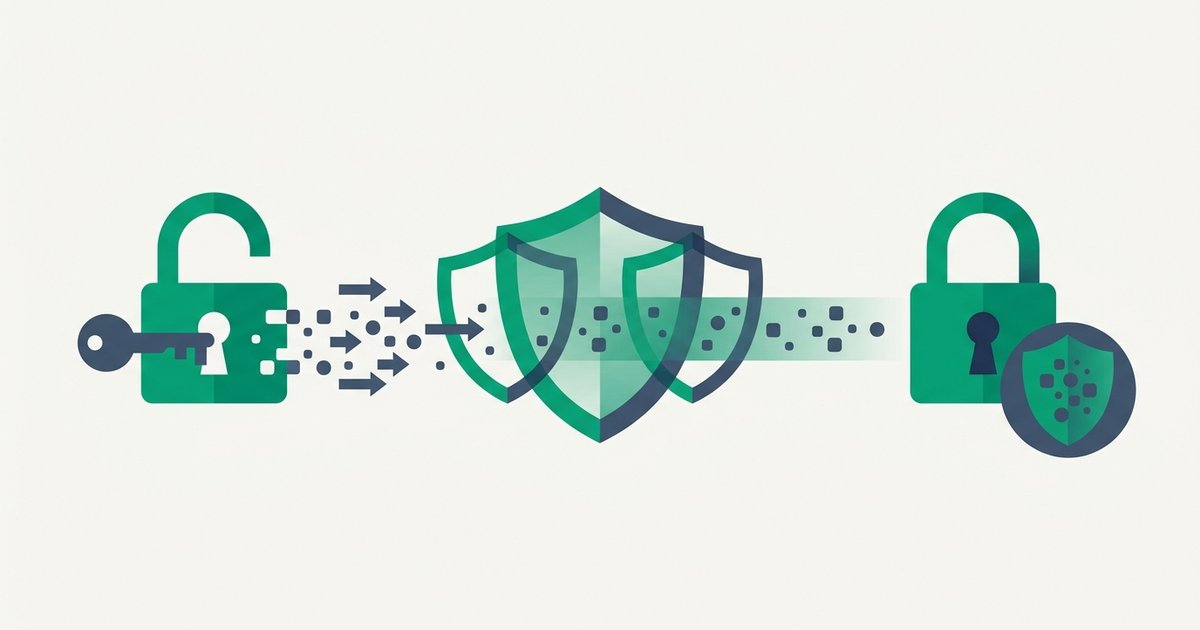
"Messages are end-to-end encrypted." WhatsApp says it, Signal says it, iMessage says it, and password managers say something very similar about your vault. It's become the trust badge of the modern internet - And one of its most misunderstood phrases. End-to-end encryption (E2EE) is a specific, verifiable engineering claim: the data is encrypted on your device and decrypted only on the recipient's device, and the company in the middle holds ciphertext it mathematically cannot read. Understanding what that does - And pointedly does not - Protect is worth ten minutes of anyone's time.
The two "ends" are devices, not companies
Every message you send crosses a chain: your phone → your WiFi → your ISP → the app's servers → the recipient's ISP → their phone. The question that defines E2EE is simple: at which points does the data exist in readable form?
- No encryption: readable everywhere. (Email between some older servers still works this way.)
- Encryption in transit: readable at each server hop. HTTPS/TLS protects the pipes, but the service in the middle decrypts, processes, and stores your data in a form it can read.
- End-to-end encryption: readable only on the two end devices. Servers relay and store ciphertext - Random-looking bytes - And even a subpoena, a rogue employee, or a full server breach yields nothing readable.
That middle case trips people up constantly. Gmail uses excellent transport encryption, yet Google's servers read your mail - That's how spam filtering and search work. The padlock in your browser means the road is safe, not the destination. It's the difference between a sealed envelope and an armored truck carrying postcards.
How devices agree on a secret without sharing it
The puzzle at the heart of E2EE: two devices that have never met must agree on an encryption key, over a channel where everything - Including the key exchange itself - Passes through the company's servers. Sending the key would defeat the purpose.
Public-key cryptography solves this. Each device generates a key pair: a public key it shares freely and a private key that never leaves the device. Anything encrypted with your public key can be decrypted only by your private key. Diffie–Hellman key agreement takes this further: both parties combine their own private key with the other's public key and independently arrive at the same shared secret - A value that never travels across the wire at all.
In practice, modern messengers layer far more on top. The Signal protocol - Used by Signal, WhatsApp, and Google Messages - Adds the "double ratchet": the encryption key changes with every single message. That yields two properties with intimidating names and simple meanings:
- Forward secrecy: steal today's key and you still can't read yesterday's messages.
- Post-compromise security: the conversation automatically "heals" back to secrecy after a temporary compromise ends.
The heavy lifting of encrypting actual content is then done by a symmetric cipher, almost always AES-256 or ChaCha20. If you want a hands-on feel, our AES-256 tool runs the same class of encryption in your browser - Watch plaintext become ciphertext with a key, and notice the output is useless without it. For the deeper mechanics, see our guide to how AES-256 actually works.
Transit encryption vs end-to-end at a glance
| Encryption in transit (HTTPS) | End-to-end encryption | |
|---|---|---|
| Protected against eavesdroppers on the network | Yes | Yes |
| Provider's servers can read content | Yes | No |
| Survives a full server-side breach | No - Stored data may be readable | Yes - Servers hold only ciphertext |
| Provider can scan, search, target ads on content | Yes | No |
| Provider can hand readable content to authorities | Yes | No - It has none to hand over |
| Content search / spam filtering server-side | Easy | Hard - Must happen on-device |
Where you already use E2EE (sometimes without knowing)
Messaging gets the headlines - Signal, WhatsApp, iMessage (between Apple devices), and Facebook Messenger, which completed its rollout of default E2EE in 2023–2024. But the same architecture protects other things you rely on:
- Password managers. A good vault is end-to-end encrypted between your own devices: encrypted locally with keys derived from your master password, synced as ciphertext. The company can't read your logins, which is exactly the property you want. Our Password Wallet works this way, and the broader design is called zero-knowledge architecture.
- iCloud Advanced Data Protection / encrypted device backups, which extend E2EE to photos and backups when enabled.
- Passkeys, which sync between your devices end-to-end encrypted - The platform relays them but can't extract the private keys. Our passkeys explainer covers how that changes login security.
One place E2EE remains rare: standard email. SMTP was designed in the 1970s with no encryption at all; bolted-on solutions like PGP exist but have never reached mainstream usability.
The one-line test: if you can log in on a brand-new device with only your password and instantly see all your old messages readable, ask where the keys live. True E2EE requires your keys - From an old device, a recovery code, or a backup only you can unlock.
What E2EE does not protect
This is the section marketing departments skip. End-to-end encryption secures data in motion between endpoints. The endpoints themselves remain the soft target:
- Your device. Malware or an infostealer on your phone reads messages exactly as you do - After decryption. E2EE is irrelevant to a compromised endpoint.
- Your screen and their screenshots. The recipient can copy, forward, or photograph anything. Encryption doesn't create trust in people.
- Backups. For years, WhatsApp chats backed up to Google Drive or iCloud in readable form unless users enabled encrypted backups - A quiet hole in an otherwise strong system. Check your backup settings; that's often where the "end-to-end" quietly ends.
- Metadata. Who talked to whom, when, how often, and from which IP address is often visible to the provider even when content is sealed. Signal minimizes metadata aggressively; most services don't.
- Your account login. If someone phishes the password protecting your account or vault, they become an "end." The strength of that one credential carries absurd weight - Make it a long random one from a password generator or a multi-word diceware passphrase, and guard it accordingly.
Why the "backdoor" debate matters
Governments periodically propose that providers retain a way to decrypt content for lawful investigations. The cryptographic reality, affirmed repeatedly by security researchers, is that there is no such thing as a hole only good guys can use. A master key or scanning mechanism becomes the single most valuable hacking target on Earth, and history - From the 1990s Clipper Chip to the 2024 compromise of lawful-intercept systems at major U.S. telecoms - Shows such mechanisms get abused and breached. Systems are either end-to-end encrypted or they aren't; "E2EE with exceptional access" is a contradiction in terms.
FAQ
Is HTTPS the same as end-to-end encryption?
No. HTTPS encrypts the connection between your device and a server, so network eavesdroppers see nothing - But the server decrypts and can read everything on arrival. E2EE keeps data encrypted through the server, readable only on the end devices. Every E2EE app also uses HTTPS; the reverse is rarely true.
Can WhatsApp or Signal read my messages if police ask?
Not the content - The servers hold ciphertext with no keys to open it. What providers can produce varies: Signal has demonstrated in court filings that it can supply almost nothing beyond account creation and last-connection dates, while services with more metadata can reveal contact patterns and timing. Content on a seized, unlocked phone is a different matter entirely.
If it's end-to-end encrypted, why do I see my old chats on a new phone?
Because they arrived via some form of backup or device-to-device transfer - And the security of that path is the thing to check. Encrypted backups (protected by a key or password only you hold) preserve the E2EE guarantee; plain cloud backups do not. If old messages appear with no backup passphrase ever involved, the provider could access them too.
Does end-to-end encryption slow my messages down?
Not noticeably. Symmetric ciphers like AES-256 are hardware-accelerated on modern phones and encrypt a message in microseconds; the Signal protocol's ratcheting adds trivial overhead. The heaviest step, the initial key agreement, happens once per conversation and completes in milliseconds.
Is my password manager end-to-end encrypted?
Reputable ones are, in the sense that matters: your vault is encrypted and decrypted only on your devices, using keys derived from a master password the company never receives. The server syncs ciphertext between your own endpoints. Verify the vendor publishes a security whitepaper saying exactly this - The design is usually labeled "zero-knowledge."